UL event spotlights importance of language coaching to meet demand for ‘rapid upskilling’
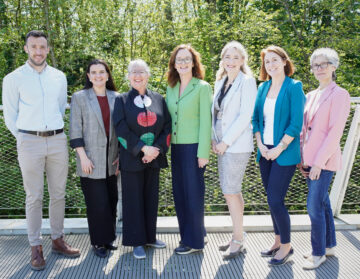
A Community of Practice for Language Coaches who support language learning and language use, and the Irish language in particular, in workplace, educational and community settings has been established by University of Limerick experts.
A special interest group – comprising UL academics, Dr. Deirdre Ní Loingsigh and Dr. Catherine Martin, participants from three UL language coaching micro-credential cohorts since 2024, and key Irish language stakeholders – held its first meeting at a dedicated one-day event on UL campus. The event aimed to explore the potential of language coaching, the supports required to sustain and embed the practice effectively, and the mechanisms through which its impact can be measured and evidenced.
The event and establishment of a community of practice is especially pertinent considering the reference to language coaching in the recently published Government Action Plan for Irish Language Public Services 2026-2028. Under Theme 4 of the Plan, public bodies will assign at least one staff member as a ‘language coach’, who will be provided with training for such a role through an accredited course.
UL is currently the only third-level institution in Ireland to provide a dedicated language coaching micro-credential, and participation from professionals across Ireland right through to Canada, Wales, Italy and Belgium highlights international interest in the initiative also.
Dr Deirdre Ní Loingsigh, Stiúrthóir na Gaeilge and Associate Professor in UL’s School of English, Irish, and Communication and the Centre for Applied Language Studies, noted that one of the main outcomes of the event was the gathering of participants from three different cohorts of UL’s Language Coaching in the Workplace micro-credential, and a broad range of settings, to share how they have been applying their coaching skills, and building on these in various professional and community contexts.
“While many of the participants on the day are working in supporting the learning and use of Irish, we had examples of language support for English as a Second or Other Language (ESOL) in Italy, Welsh in Wales, French in Canada, as well as Irish in the community, public sector and higher education settings, in Ireland,” said Dr Ní Loingsigh.
The event also provided an opportunity for engagement with external stakeholders, with input and suggestions from Foras na Gaeilge and Údarás na Gaeltachta greatly enriching the discussion on the future potential, supports, and measurable impact of language coaching in Ireland.
The financial support from the Higher Education Authority (HEA) through the Human Capital Initiative (UL@Work), and Special Provision for the Support of the Irish Language (2025) for the CPD event is acknowledged.
Commenting on the Inaugural Community of Practice Meeting, of Language Coaches, Dr. Sarah Brady, UL MicroCreds Project Lead said, “micro-credentials demonstrate UL’s approach to enable rapid upskilling and reskilling, through targeted, accredited education that is accessible, agile and aligned with workforce transformation.”
An important outcome of the event, which coincided with Research Week 2026 at UL, is the strengthened international research and practice collaboration with the Official Languages Centre of Excellence, Government of Canada through the participation of Louise Varagnolo as guest workshop facilitator.
Dr Ní Loingsigh explained: “There are many synergies between the official languages contexts in Ireland and Canada, and much interest in how language coaching might be operationalised as a new layer of language support, or a new intervention in the organisational or institutional setting.”
After a follow-up Think-Tank earlier this month, UL academics leading the Community of Practice are looking forward to further consultation with Irish language stakeholders, drawing further attention to the scope of language coaching to support ESOL in Ireland, and developing new links established with the Centre for Implementation Research at UL (CIRcUL).