Facilitating the Growth of Social Enterprise in Rural Areas
Social enterprises develop practical solutions to social challenges, with the primary goal of creating social value rather than private profit. These can include community centres or social employment schemes, for example.
Despite their growing importance in rural areas, such as the Gaeltacht, many social enterprises across Nothern Europe operate without long-term funding, clear regulatory frameworks or support tailored to their needs. As a result, their potential to contribute to local services, job creation and social inclusion remains constrained.
The MERSE recommendations – the first of their kind in Northern Europe – draw on research, surveys and dialogue with social entrepreneurs and policymakers in Finland, Iceland, Norway, Sweden and Ireland. Together, they outline what is needed to create more stable and enabling conditions for social entrepreneurship.
“Social enterprises are increasingly expected to address societal challenges, without always being given the tools they need. That is not sustainable. There is political will, but existing systems are often not designed for how these organisations actually operate. These recommendations show what needs to change,” says Rónán Mac Con Iomaire, Director of Regional Developement, Community & Language Planning in Údarás na Gaeltachta.
Five areas for policy reform
The policy recommendations identifies five priority areas for action.
First, it calls for clearer political recognition of social enterprises, including shared definitions and improved data. A central proposal is the introduction of “rural proofing” – ensuring that policies are systematically assessed for their impact on rural areas.
Second, the report highlights the need for long-term funding. Short-term project grants are described as a recurring barrier. Instead, it proposes multi-year funding schemes alongside blended finance models combining grants, loans and development support, adapted to smaller organisations.
Third, public procurement is highlighted as a strategic lever. Greater use of social criteria could open up opportunities for social enterprises while strengthening local services, labour market integration and care provision.
The report also points to the need for more targeted support systems, including advisory services that reflect the realities of cooperative and community-based business models, as well as better tools to measure and demonstrate social impact.
Finally, it argues that social enterprises should be seen as strategic partners in local and regional development, particularly for municipalities facing challenges related to service delivery, workforce shortages and social inclusion.
An underused resource
MERSE concludes that social enterprises represent a significant, but still underused, resource in rural development.
“Social enterprises are already creating jobs and addressing societal needs where other actors fall short. With the right conditions, they could play a much stronger role in rural development,” says Fionnán Ó hÓgáin, Research and Business Development Executive at Údarás na Gaeltachta.
Cross-border collaboration
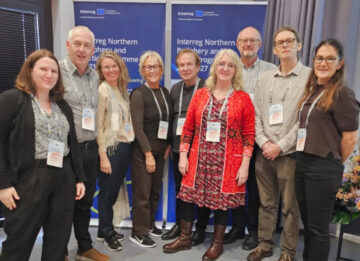
The MERSE project research – Business Models Empowering Rural Social Entrepreneurship, running was carried out between 2023 and 2026 as part of the EU’s Interreg Northern Periphery and Arctic (NPA) programme. The project brings together researchers, public bodies and support organisations from Finland, Ireland, Iceland, Norway and Sweden. It is funded by Interreg NPA, alongside Region Jämtland Härjedalen and Region Västernorrland.
According to the project team, international collaboration has been key.
“Many of the challenges are shared across Northern Europe. Working together has made it possible to identify solutions that are both widely relevant and adaptable to local contexts,” says Éamonn Ó hÉanaigh Head of Community Development in Údarás na Gaeltachta.
From recommendations to reform
The next step is implementation. As many rural areas face declining populations, labour shortages and reduced access to services, the report outlines how social enterprises could become a more integral part of long-term development strategies — provided the right policy conditions are in place.